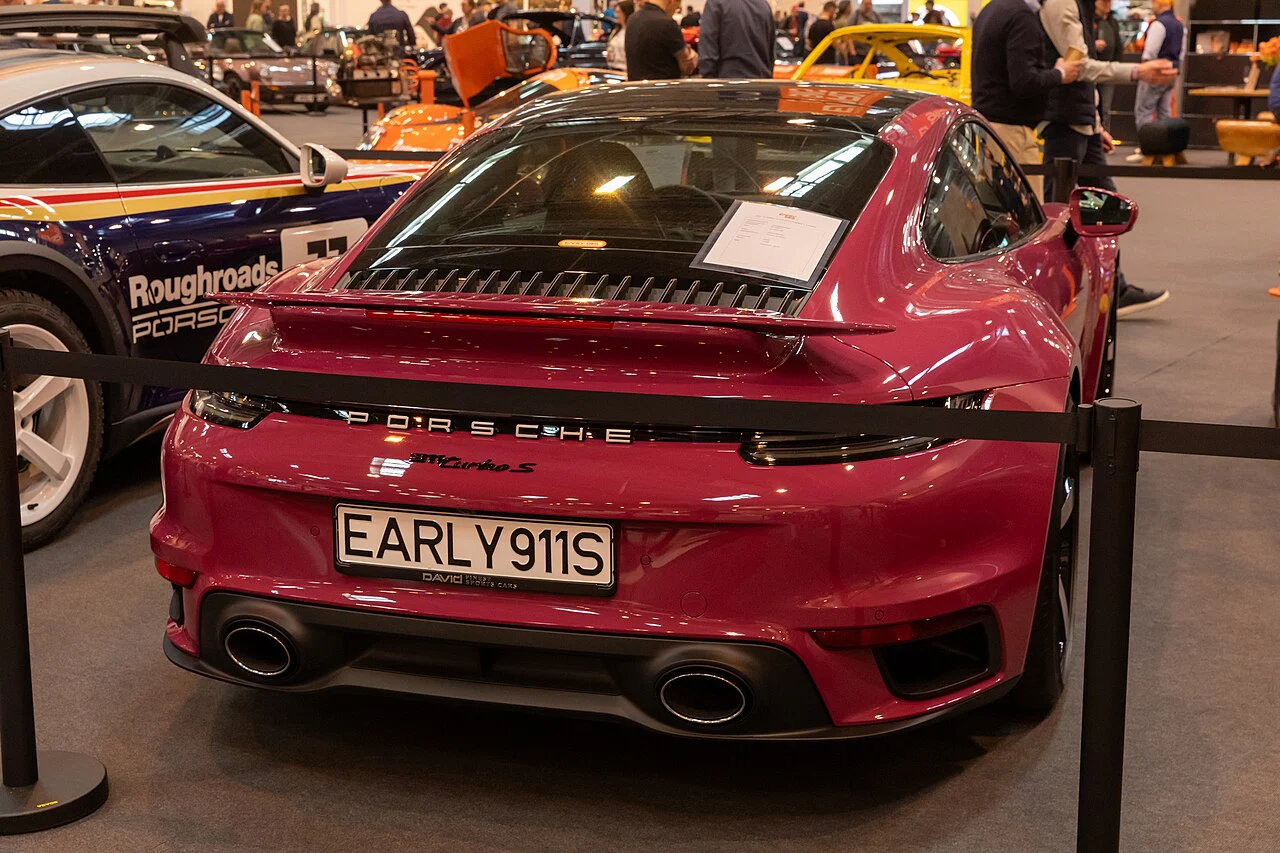
The 911 Turbo S is technically a supercar, with 701-hp and face-melting acceleration, but it is also a supremely low-drama exotic that’s normal and easy to live with. It makes for a great commute in a crowded and slow city because you don’t need fast accelerations to feel the power and thrill of this supercar. Unlike most supercars, it’s refined, comfortable so you can drive in the city without drawing too much attention or getting bored by your car.
The 911 Turbo S is sophisticated and restrained next to its flamboyant supercar rivals. It looks like a 911, not a show car.
The Most Powerful Production 911 Ever Made
Yet outside of the city the 911 Turbo S becomes what it truly is: a supercar. It’s the most powerful production 911 ever made, with 701 hp from a twin-turbocharged 3.6-liter flat-6 engine and electric motor hybrid system. Porsche claims a zero to 60 time of just 2.4 seconds, but Car and Driver has tested it at only 2 seconds flat. The Turbo S has the same rear-engine chassis that the 911 family always had. It is still a modern version of an old classic. Porsche claims a Nurburgring lap in 7:03.92, about 14 seconds quicker than the previous Turbo S.
Back in the city, the speed limit for NYC is twenty-five miles per hour unless signed. Speed camera tickets cost fifty dollars. There’s no need to go fast to feel fast. Being stuck in traffic can be interesting when you’re driving the 911 Turbo S. The standard suspension is perfect for this car, so you don’t need to get the optional Sport package which stiffens up the suspension to the point where your back will hurt from potholes.
In some cases, a steep driveway or steep parking garage ramp could scrape the front bumper. The Turbo S offers an optional front axle lift that raises the nose. It raises faster than previous systems. Check whether your car has it before you go.
The 911 Turbo S is a great city car, although it does not have a lot of room for people. The rear jump seats are too small for adults to use them as seats, but you can fold them down and use them to create a flat area that holds several carry-on suitcases. The front trunk has space for at least one more carry-on.
The 911 Turbo S has a more luxurious cabin than the Carrera model. The controls are simple and easy to use, and the infotainment system has a 10.9-inch touchscreen that supports wireless Apple CarPlay and Android Auto. You get a 12-speaker Bose sound system standard, but adaptive cruise control costs extra. The standard safety equipment on the 911 Turbo S includes automated emergency braking, lane-keeping assist, and parking sensors. The parking sensors are useful in tight spots. Optional extras include night vision.
If you are driving into Manhattan at or below 60th Street, during peak hours (5am-9pm weekdays, 9am-9pm weekends) there is a $9 congestion toll with E-ZPass or $13.50 if billed by mail. Check that your car has E-ZPass before leaving. As for fuel, the 911 Turbo S gets 15 mpg in the city, 22 on the highway, and 18 combined. That’s only about 3 mpg less than the Carrera, but nearly twice as much horsepower.
The base price for the Porsche 911 Turbo S is $270,300. That matters when you rent one: for car prices above $50,000, there is no cap on damage waiver prices in New York State law. It can be fair market value. The rental company can’t charge you for loss-of-use or administrative fees after you damage their vehicle.
New York law says that rental firms can’t refuse to rent a car to anyone 18 or older just because of their age, as long as insurance for that age is available. In New York State, most cars must have at least $25,000 of coverage for bodily injury liability per person. Ask the rental company what the coverage is on your car.
The 911 Turbo S has enough power for you to feel really fast without breaking any laws. It’s the perfect exotic for the city. It is surprisingly easy to live with and plenty practical.